The process and the retreat
7 days, 14 hours ago
If I didn't have a family around me, I would—just like during my painting days—produce, produce, produce without stopping. And I would constantly be frustrated that my knowledge input is too small and that I am too slow to replenish the supply. When I paint, I think, and I organize my mind.
The same thing happens when I march for miles. There is a specific point during walking and running where the momentum carries the legs and the entire body in such a way that—if the rhythm remains uninterrupted—I could run like a machine without any exertion. Purely from the musculoskeletal system. I become like a mobile in perfect balance; it requires no effort. In those moments, my mind gains space. I firmly believe that the periphery around my body—this invisible expanse—occupies a great deal of real space. When I see some people running, I just think: „Damn, how inefficient. Find your momentum!“
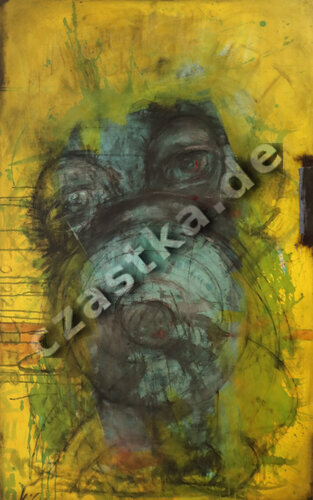
I experience phases of dark days. They border on a psychological paralysis. During those times, I probably haven't fed my protons in the nucleus, and the electrons run as solitary runners through space, searching for more. But eventually, an impulse finally arrives and sets me in motion again. Then, all of a sudden, I am capable of painting over 20 large oil canvases in about three weeks.
Due to a sheer lack of space, these formats (approx. 80x100 cm) used to hang from a clothesline in the studio, drying away when I urgently needed more pieces for my exhibitions in Brussels. I delivered them to Brussels "still warm"—meaning completely wet and without any final varnish. I had started there with an exhibition at the European Parliament and was subsequently passed from success to success, all the way to Dominique Rigo.
But right there, I realized that it wasn't enough. I need fundamental input to sustain that kind of output. I do not paint continuously. My professor at the academy painted in the morning until the break and kept going in the afternoon—with the rigid regularity of brushing one's teeth. I cannot do that. I have to walk, forage, and stare at things and people with the eternal question of how it all works at its core. I visualize systems, question, cross-reference, correct my thoughts, and connect things in my own unique way—connections that apparently not many people bring together. And once the critical mass is reached, I paint. Explosively and all at once, until stability returns to the system.
In Brussels, I eventually just left all the paintings behind. I departed.
After leaving Brussels, I moved across Europe for a while as part of the project and for my later work—living in The Hague, Lille, Dortmund, and Berlin, before finally settling permanently in the Ruhr area. Until around 1999, I was involved in the "Eyes of Europe" project—an interdisciplinary framework of European telecommunications experts, lawyers, technicians, notaries, and pedagogy professors working on an official White Paper for European learning. Strictly speaking, I didn't write the White Paper myself; rather, as the central organizer in the background, I was responsible for the implementation and integration—always acting according to the instructions of the visionary and initiator. From this intensive period, I extracted an enormous amount of structural knowledge.
This foundation was so profound that I was subsequently able to work successfully as a project manager and, until 2013—interrupted by maternity leaves for my 4 children—at IKEA in the Ruhr area as a department head for Interior Design and Visual Merchandising. There, over the course of years, I was profoundly fascinated by recognizing and decoding the highly complex psychological spatial strategies that IKEA implements within its system—an art that hardly any employee understands in its true depth. I was organizing structures in space and design.
Therefore, I took the next step into digital infrastructure: following intensive training in web and media design, HTML and CSS, project management, as well as crucial areas for understanding how a programming language operates, I have been permanently employed at TIV-Consulting since 2015. This work made me intensely aware of how precisely spaces must be measured so as not to break a layout: a single pixel is enough to dissolve a structure and cause utter chaos. I grasped the invisible mechanisms of compression in both the analog and digital realms, in spatial psychology as well as in programming code.
To this day, I never followed up on it. Before that, I had been quite successful selling my elephant paintings and portraits, always managing to finance my way forward somehow. I am driven by and dependent on the process, yet every completed work is a real piece of my energy. Today, I need the value of this physical mass to secure my family and to fight for the free space required for scientific research in the first place.
What is done goes its own way.
Although I am convinced: nothing is ever truly finished.